AI tools feel incredibly powerful in 2026 🚀. They can write content, analyze data, automate workflows, brainstorm ideas, and support complex decision-making. On the surface, it seems like anyone should be able to succeed with AI.
Yet many professionals feel stuck and frustrated.
They try new prompts ✍️
They jump between tools 🔁
They follow trends and tutorials 📉
And the results still feel inconsistent, generic, or unreliable.
The problem is not AI itself.
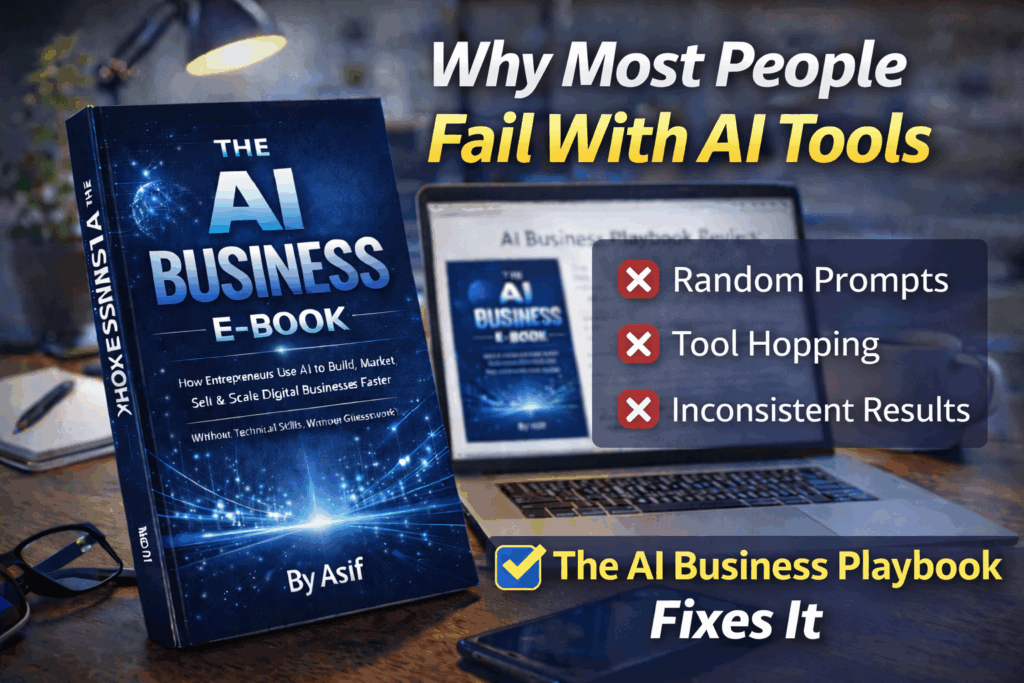
Most people fail with AI tools because they use them without a clear strategy.
👉 Read the AI Business Playbook Review
The Real Reason AI Tools Fail for Most Users 🧩
AI does exactly what it is instructed to do. The issue is that most instructions are unclear, reactive, or disconnected from real business or career goals.
Common mistakes include:
- ❌ Using AI without a defined objective
- ❌ Asking questions without context
- ❌ Tool hopping instead of building systems
- ❌ Expecting AI to replace thinking
When direction is weak, output becomes shallow. This causes users to blame the tool, when the real issue is unclear thinking behind the input.
Why Prompt-First AI Usage Backfires ⚠️
Many people believe that better prompts automatically lead to better results. This creates an obsession with prompt libraries, templates, and shortcuts.
But prompts are only instructions.
If the strategy behind them is weak, the output will always be weak too.
The truth is simple:
- Weak thinking produces weak AI output
- Clear thinking produces strong AI output
The AI Business Playbook shifts focus away from prompt chasing and toward structured thinking.
Where Most Professionals Get Stuck 🔄
Without a framework, AI usage becomes reactive instead of intentional.
People often:
- Ask AI different questions every day
- Get different answers every time
- Struggle to reuse outputs
- Lose confidence in decisions
This is not an AI limitation. It is a process problem.
👉 See How the AI Business Playbook Solves This
How the AI Business Playbook Reframes AI Usage 🎯
Instead of starting with “what should I type,” the Playbook teaches users to think first.
It trains you to clearly define:
- 📌 Business or career context
- 📌 Desired outcome
- 📌 Constraints, boundaries, and priorities
Once these are clear, prompts become obvious and results become repeatable. AI stops guessing and starts assisting.
This framework works across tools like ChatGPT, Claude, and Gemini because it is tool-agnostic.
From Random Output to Predictable Results 📊
Without strategy:
- AI responses change every time
- Messaging feels inconsistent
- Decisions feel uncertain
With a strategy-first approach:
- Workflows become repeatable 🔁
- Brand voice stays consistent 🧠
- AI supports long-term goals 📈
The Playbook helps users move from experimentation to execution by turning AI into a structured thinking partner.
Why This Matters for Professionals 💼
For professionals, AI is not a novelty. It is a business asset.
Used correctly, AI can support:
- Market research 🔍
- Content systems 📝
- Strategic planning 🧠
- Career positioning 🚀
Used incorrectly, it creates noise, wasted time, and false confidence.
The AI Business Playbook fills this gap by teaching how to think with AI, not just how to prompt it.
Who Benefits Most From This Approach 👥
This approach is ideal for:
- Entrepreneurs and founders
- Freelancers and consultants
- Coaches and creators
- Professionals using AI daily
It is not designed for shortcut seekers or prompt collectors who avoid critical thinking.
Final Thoughts 🌟
Most people do not fail with AI because the tools are weak. They fail because they approach AI without clarity.
The AI Business Playbook fixes this by introducing structure, strategy, and professional-level thinking. When those are in place, AI becomes predictable, reliable, and genuinely useful.