AI tools are no longer optional in 2025. They are becoming a core part of how professionals research, create, communicate, and make decisions. Yet despite this power, many people still struggle to use AI in a way that actually improves their business or career.
They ask AI what to do next 🤔
They test random prompts ✍️
They rely on trial and error 🔁
And progress feels slow or unpredictable.
The issue is not a lack of tools.
The issue is a lack of strategy-first thinking.
👉 Read the AI Business Playbook Review
Why “Just Ask AI” Is a Weak Strategy ⚠️
Many users treat AI like a shortcut. They expect the tool to figure everything out for them.
This leads to common problems:
- AI gives generic advice
- Outputs change every time
- Suggestions feel disconnected from real goals
- Decisions feel unclear
AI does not fail here. The approach fails.
Without context, AI cannot align with your business, career path, or long-term direction.
What Strategic AI Usage Actually Means 🧠
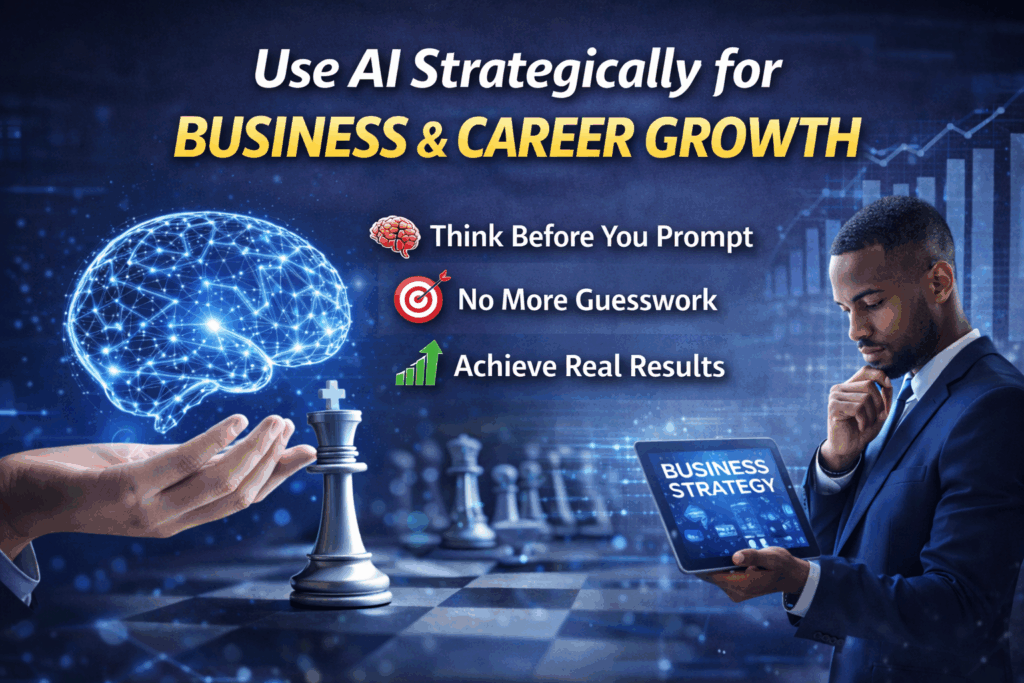
Using AI strategically means thinking before you prompt.
Instead of asking:
“What should I do?”
You first define:
- Your role or business context
- The outcome you want
- The constraints you must operate within
Only then does AI become useful.
This shift turns AI from a guessing engine into a thinking assistant.
The Difference Between Tactical and Strategic AI Use 🧩
Tactical AI use looks like:
- Writing one-off posts
- Generating random ideas
- Asking AI to fix problems without understanding them
Strategic AI use looks like:
- Designing repeatable workflows
- Supporting decisions with research
- Aligning output with long-term goals
- Maintaining consistency across work
The second approach compounds over time 📈.
How Professionals Can Use AI for Career Growth 💼
For career-focused users, AI works best when it supports clarity and positioning.
Strategic use includes:
- Refining professional narratives
- Improving resumes and LinkedIn profiles
- Preparing for interviews
- Practicing communication and negotiation
AI becomes a mirror for thinking, not a replacement for it.
👉 See How the AI Business Playbook Teaches This Approach
How Businesses Benefit From Strategic AI Thinking 📊
For entrepreneurs and business owners, AI should support decisions, not just output.
Used strategically, AI can help with:
- Market and customer research 🔍
- Offer validation before building
- Content systems instead of random posts
- Ethical sales messaging
- Internal documentation and SOPs
This reduces wasted time and improves confidence.
Why Prompt Guessing Leads to Burnout 🔄
When users rely on guessing prompts:
- They constantly rewrite inputs
- They doubt AI responses
- They lose trust in their own decisions
This creates mental fatigue.
A structured approach removes guesswork. Once the thinking framework is clear, prompts become simple and repeatable.
Where the AI Business Playbook Fits In 📘
The AI Business Playbook focuses on how to think, not just what to type.
It teaches:
- Strategic clarity before execution
- Outcome-driven AI usage
- Consistent systems over one-off hacks
- Tool-agnostic frameworks that scale
This is why it works across platforms like ChatGPT, Claude, and Gemini.
Who This Strategic Approach Is Best For 🎯
This method is ideal for:
- Entrepreneurs and founders
- Freelancers and consultants
- Coaches and creators
- Professionals integrating AI into daily work
It is not designed for people chasing shortcuts or prompt collections.
Final Thoughts 🌟
AI becomes powerful when paired with clear thinking.
If you approach AI without direction, it feels unreliable.
If you approach AI with strategy, it becomes a force multiplier.
Learning how to think before you prompt is what separates casual users from professionals.